Lantana camara
Lantana camara | |||||||||||||||||
|---|---|---|---|---|---|---|---|---|---|---|---|---|---|---|---|---|---|
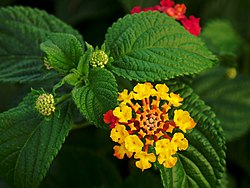 Flor de Lantana camara | |||||||||||||||||
Classificação científica | |||||||||||||||||
| |||||||||||||||||
Nome binomial | |||||||||||||||||
Lantana camara | |||||||||||||||||


Flores de Lantana camara
A Lantana camara, conhecida popularmente como camará, cambará, camará-de-cheiro, camará-de-espinho, cambará-de-cheiro, cambará-de-chumbo, cambará-de-espinho, cambará-miúdo, cambará-verdadeiro e cambará-vermelho, é um arbusto ornamental da família das verbenáceas.[1] Cobre grandes áreas nas Américas Central e do Sul, seu habitat natural.
Índice
1 Etimologia
2 Descrição
3 Espécie invasora
4 Referências
Etimologia |
"Camará" e "cambará" procedem do termo tupi caa ("planta") mbaraá ("enfermidade") e reflete seu valor medicinal.[2]
Descrição |
A planta apresenta folhas grossas, pilosas e aromáticas. As flores são pequenas, numerosas, tubulosas, vermelhas ou violáceas.[1] A Lantana camara é reconhecidamente tóxica, e a ingestão de quantidades aproximadas de 40g/kg de peso animal, em dose única, pode levar ao óbito de bovinos, por exemplo.[3]
Espécie invasora |
Como espécie invasora, tem colonizado novas áreas através de dispersão de sementes por pássaros — uma vez alcance uma área, rapidamente se espalha. Ela se desenvolve tão rápido que os esforços para sua erradicação têm falhado completamente.
A planta transformou-se num sério obstáculo para a regeneração natural das espécies nativas nas regiões onde não é encontrada naturalmente.[4]
Referências
↑ ab FERREIRA, A.B.H. (1986). Novo dicionário da língua portuguesa, 2ª edição. [S.l.]: Nova Fronteira. 324 páginas
↑ Adm. do IHGRS (1941). Revista do Instituto Histórico e Geográphico do Rio Grande do Sul, volume 21,Parte 3. [S.l.]: Edit. própria
↑ F. J. Abreu Matos; et al. (2011). Plantas Tóxicas: Estudos de Fitotoxicologia Química de Plantas Brasileiras. [S.l.]: Instituto Plantarum de Estudos da Flora. pp. 175–176. ISBN 85-86714-37-5 !CS1 manut: Uso explícito de et al. (link)
↑ Khanna, L.S. (1977). Principles and Practice of Silviculture. [S.l.]: Ed. própria. 473 páginas


